

Most outdoor solar security cameras need 2–4 peak sun hours per day to stay charged.
If you want clear, reliable security footage year-round, you need to know how much sunlight does outdoor solar security camera need. I install and test these systems in varied climates, and small setup choices can double your uptime.
In this guide, I explain how much sunlight does outdoor solar security camera need, how to size panels and batteries, and how to avoid the common mistakes that drain power when you need it most.
How Much Sunlight Do Solar Security Cameras Need?
Sunlight basics: peak sun hours vs daylight
Not all daylight is equal. What powers your camera is peak sun hours, not the number of hours it looks bright outside. One peak sun hour equals 1,000 watts per square meter of solar energy for one hour. It is a way to measure the total useful energy in a day.
If you are asking how much sunlight does outdoor solar security camera need, think in peak sun hours. Most areas in the United States get 2–6 peak sun hours depending on season and location. Summer gives more. Winter gives less. Clouds, shade, and low sun angles cut output fast.
A quick rule helps. If your camera uses 2 watt on average and your panel makes 4 watt in full sun, you need about 2–4 peak sun hours per day to break even. Extra hours charge the battery for nights and bad weather.
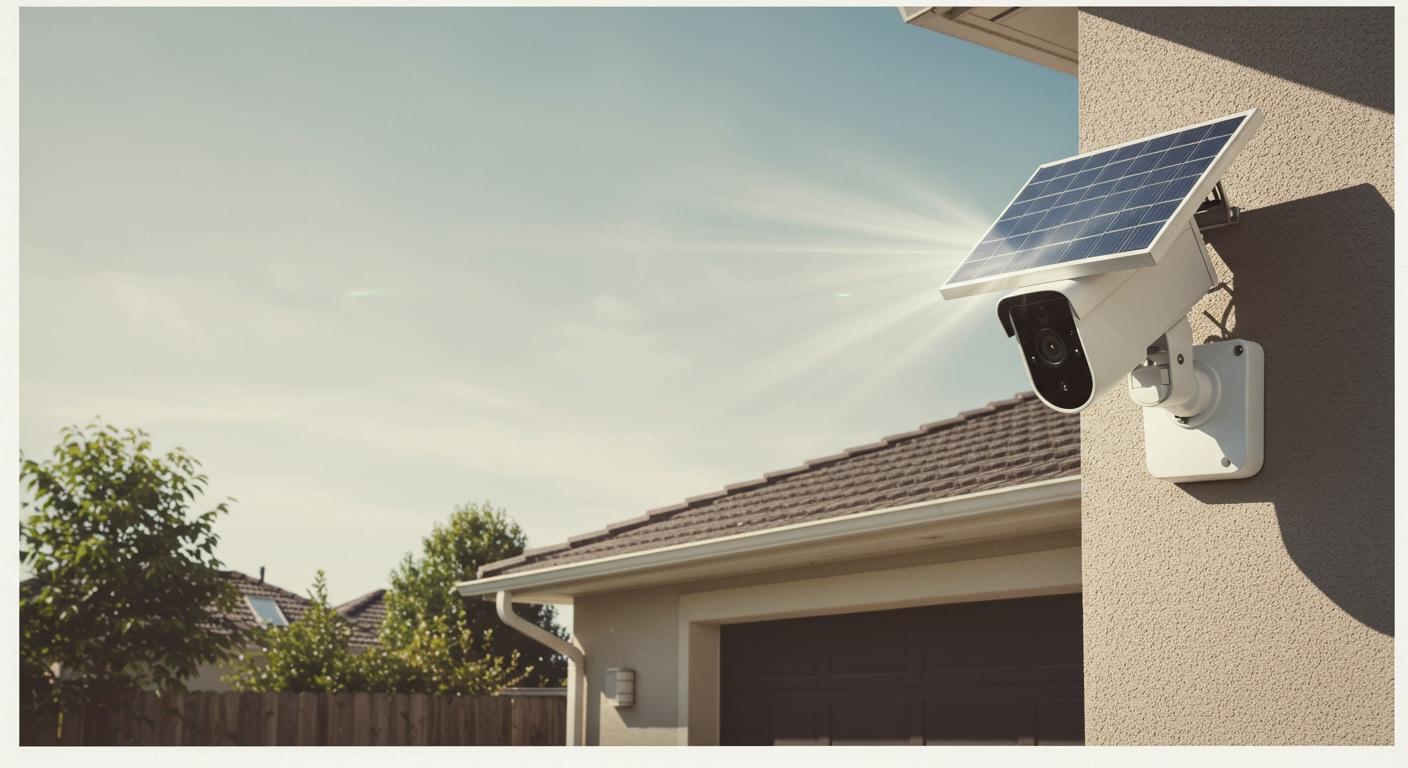
Power needs of outdoor solar security cameras
To know how much sunlight does outdoor solar security camera need, first estimate your camera’s load. Most Wi‑Fi cameras idle at 0.5–1.5 watt. They spike to 2–4 watt while recording. Models with spotlights or sirens can hit 8–10 watt during events. LTE models draw more, often 1.5–3 watt idle.
Batteries smooth the load. A typical camera battery holds 5–10 watt‑hours. External batteries hold 20–40 watt‑hours or more. Bigger batteries do not reduce how much sunlight does outdoor solar security camera need per day, but they guard against cloudy stretches.
Use this simple path to size your system:
- Find average power. If idle is 1 watt and recording raises it to 2 watt for one hour per day, your daily energy is about 1×23 + 2×1 = 25 watt‑hours.
- Check your panel. A 5 watt panel in a 4 peak sun hour area gives about 5×4 = 20 watt‑hours daily before losses. Real output after losses is closer to 70–80%.
- Match or exceed the load. If you fall short, raise the panel size, add sun hours via better placement, or reduce camera activity.

How much sunlight does outdoor solar security camera need by region and season
Climate matters a lot. The same camera can thrive in Arizona and struggle in Oregon. This is where how much sunlight does outdoor solar security camera need shifts through the year.
General ranges for daily peak sun hours in the U.S.:
- Southwest deserts: 5–7 in summer, 3–5 in winter.
- California coast: 5–6 in summer, 2–4 in winter.
- Midwest: 4–6 in summer, 2–4 in winter.
- Northeast: 4–5 in summer, 1.5–3.5 in winter.
- Pacific Northwest: 4–5 in summer, 1–3 in winter.
If your winter sun is low, plan for your worst month. That is how you answer how much sunlight does outdoor solar security camera need and still avoid dead batteries in January. In dim winters, you may need a larger panel, a bigger battery, or tighter motion settings.

Placement, tilt, and orientation best practices
Even a great panel fails if you place it wrong. The better your placement, the less how much sunlight does outdoor solar security camera need to meet its daily load.
Follow these basics:
- Face the panel south in the Northern Hemisphere. Face north in the Southern Hemisphere.
- Use a tilt near your latitude. Steepen the tilt by 10–15 degrees for winter focus.
- Keep it out of shade from trees, vents, eaves, and poles. Even a small shadow can cut power by half.
- Mount with airflow to reduce heat. Hot panels make less power.
- Keep it within the cable limit but not under the roof overhang.
I often angle winter panels steeper on north homes to catch low sun. This alone can raise effective sun hours, which reduces how much sunlight does outdoor solar security camera need from an oversized panel.

Real-world lessons from the field
My team installed a solar camera in Phoenix on a south wall with a 5 watt panel. It ran at 85% battery most days. The same model in Seattle needed a 10 watt panel and a larger battery to stay above 50% in winter. Both were fine in summer.
Mistakes to avoid:
- Mounting under an eave. The roof blocks low winter sun.
- Using narrow view motion in a busy area. Extra triggers drain power fast.
- Aiming the panel flat. Flat mounts catch less winter sun, so how much sunlight does outdoor solar security camera need goes up.
Small tweaks saved many calls. A 15 degree tilt change plus trimming one branch often doubled winter charge.
Sizing guide: panel and battery made simple
Here is a simple way to size for how much sunlight does outdoor solar security camera need.
Steps:
- Estimate daily energy use. Example: 24 watt‑hours.
- Find your worst month sun hours. Example: 2.5 peak sun hours.
- Choose panel wattage. Target daily panel energy at 1.5× your load to cover losses. 24 × 1.5 = 36 watt‑hours needed. At 2.5 peak sun hours, panel wattage ≈ 36 ÷ 2.5 = 14.4 watt. Use a 15–20 watt panel.
- Size the battery for at least 2–3 days of autonomy. 24 × 3 = 72 watt‑hours. Many camera kits use smaller packs, so reduce motion or raise panel size if you cannot expand the battery.
Example kits:
- Porch cam with light traffic in sunny states. 5–10 watt panel. Small built‑in battery. How much sunlight does outdoor solar security camera need here is about 2–3 peak sun hours.
- 2K video with spotlight in mixed climate. 10–20 watt panel. 20–40 watt‑hour battery. Needs 3–4 peak sun hours.
- LTE rural gate cam. 20–30 watt panel. 40–80 watt‑hour battery. Needs 3–5 peak sun hours, more in winter.
Seasonal and weather impacts to plan for
Winter is the stress test. Low sun angles, clouds, and snow can starve the panel. Dust and pollen in spring also reduce output. Heat in summer lowers panel voltage and can cause throttling on some cameras.
Plan for the worst month first. This lowers how much sunlight does outdoor solar security camera need on average because you avoid deep drains and emergency trips. Add a bit of tilt for winter, clean the panel monthly, and watch the battery trend. If battery drops below 30% often, reduce motion triggers or add panel area.
Maintenance and troubleshooting when the battery keeps dropping
A few checks can fix most low charge issues. They are quick and free.
Try this:
- Clean the panel with water and a soft cloth. Dirt can cut output by 10–20%.
- Check for new shade from growing trees or shifted mounts.
- Re‑aim for true south and correct tilt. Small changes add real power.
- Update firmware and lower activity. Reduce clip length, raise motion threshold, or set schedules.
- Add panel capacity if winter is harsh. This reduces how much sunlight does outdoor solar security camera need from perfect placement alone.
If the app shows daytime charge is flat, the panel or cable may be faulty. Test with a small USB meter if your system allows it.
Myths and facts about solar security cameras
There are many myths that confuse how much sunlight does outdoor solar security camera need. Here are the big ones I see.
Common myths and the truth:
- Myth: You need full sun all day. Truth: You need a few peak sun hours, not all-day sun.
- Myth: Clouds make solar useless. Truth: Cloudy days still give 10–50% output.
- Myth: Any angle works. Truth: Angle and shade are often the top problems.
- Myth: Bigger batteries fix everything. Truth: They help, but energy in must match energy out.
- Myth: Wi‑Fi and LTE draw the same. Truth: LTE often draws more idle power.
Buying guide: features that help in low-sun areas
Choose gear that works well when light is scarce. This lowers how much sunlight does outdoor solar security camera need to run day after day.
Key features to look for:
- Larger panel options and weather‑sealed connectors.
- MPPT charge controller for better low‑light harvest.
- Bigger battery or external battery support.
- Smart power modes, like sleep schedules and event‑only recording.
- Efficient codecs such as H.265 and good PIR sensors to reduce false alerts.
- Clear solar and battery stats in the app for easy tuning.
Ask for real specs. Panel wattage, battery watt‑hours, and typical current draw. Honest numbers help you match your site.
Frequently Asked Questions of how much sunlight does outdoor solar security camera need
How many hours of sun do I need per day?
Most setups need 2–4 peak sun hours per day. Cloudy regions or high‑use cameras may need 4–6 peak sun hours and a larger panel.
Will my camera work in winter?
Yes, with the right panel size and tilt. Plan for your worst month sun and use a larger battery to ride out long cloudy runs.
Can shade for part of the day ruin charging?
Even small shade can cut output a lot. Move the panel to a clear spot and avoid morning or afternoon shadows from roofs and trees.
Do spotlights and sirens affect battery life?
Yes, they add big short bursts of power use. Limit spotlight duration and use smart motion settings to save energy.
Is LTE worse for power than Wi‑Fi?
Usually yes. LTE radios idle higher and spike on uploads, so use a bigger panel and battery for LTE cameras.
Conclusion
You now know how much sunlight does outdoor solar security camera need and how to size and place a system that just works. Focus on peak sun hours, smart placement, and honest power math. Plan for winter and give yourself a margin.
Take a few minutes today to check tilt, shade, and settings. Small changes can double your effective sun. Want more practical tips and tools? Subscribe for checklists, calculators, and field‑tested setups that keep your cameras online when it matters most.