

Night hog hunts call for clear visibility so you can spot targets and move through familiar ground with more confidence. A handheld flashlight can help, but its beam may scatter, strain your arm during long waits, or leave your hands busy when you need them.
For steadier light, a hunting light mounts to your rifle or scope and directs its beam where you aim. Red or green illumination can help you see hogs while reducing glare, and a pressure switch lets you control the beam without changing your grip.
Many models offer adjustable brightness, focused beams for longer views, and rechargeable batteries that keep spare cells out of your kit. Some include remote switches or mounting hardware, making setup simpler and keeping light close to your line of sight.
Size, beam distance, color, and battery life vary, so consider your hunting style and local rules before choosing. Explore the best hunting lights for hogs below to find a light that suits your night hunts.
8 Best Hunting Lights for Hogs Reviews

1.EcoJLigOas QA Solar Hog Feeder Light
Solar charging provides up to 16 hours of light after a 6-hour charge

2.LUMENSHOOTER A8Plus Zoomable Hunting Lights
Four color beams reach up to 450 yards to help spot game at night

3.sunlight encounter SE-SH000G Solar Hog Light
15000 lumens cover up to 1080 sq.ft. for clear nighttime visibility

4.Elusive Wildlife Outfitter Hunting Lights
Motion activation brightens the feeder area to your chosen intensity
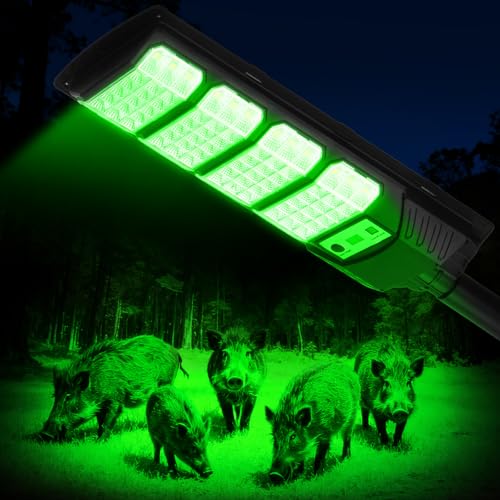
5.BINGLUX Hog Light 18,000-Lumen Hunting Light
18,000 lumens cover 780–980 sq.ft. for clear hog visibility at night

6.Tujoe MH65262 Hunting Lights 2 Pack
Two 18000LM solar lights provide wide green coverage around feeders

7.Elusive Wildlife Kill Light Pro Feeder Light
Motion activation gradually raises brightness to help keep game calm

8.VowelsOne Solar Powered Hog Feeder Light
Green LEDs cover 700–900 sq.ft. and automatically light the feeder at
1. EcoJLigOas QA Solar Hog Feeder Light
EcoJLigOas hog lights use green, motion-activated illumination to help light a feeder area for hog hunting. The two-pack offers a claimed 22,000 lumens, with 5730 LED lights that spread illumination across a 320-degree area.
Each light has two motion settings. One keeps the light at 30% brightness while the area is still, then raises it to 100% when motion appears; the other stays off until it detects movement. You can also choose three-, four- or five-hour settings.
Solar panels recharge the upgraded battery in about six to eight hours of sunlight. The lights provide up to 16 hours of illumination on a full charge, and they switch on at night and off during the day.
A metal bracket supports installation on a tree or wall, with no wiring needed. The black ABS housing is described as waterproof and suited to rain, snow and frost, while adjustable brightness lets you set the output for the area.
The lights suit hunters who want solar-powered green illumination with motion control around a feeder. Their broad coverage and two-light package offer flexibility, though the product data does not specify how the remote control works.
- Motion modes raise brightness to 100% on detection
- Solar charging provides up to 16 hours of light
- 320-degree green illumination covers a broad area
- Two lights offer more feeder coverage options
- Full recharge needs six to eight hours of sun
2. LUMENSHOOTER A8Plus Zoomable Hunting Lights
For hog hunting after dark, the LUMENSHOOTER A8Plus offers four beam options for different conditions and distances. Its green beam reaches 350 yards, the red beam reaches 250 yards, and the white beam reaches 450 yards; it also includes an 850nm infrared module.
You can swap the LED modules without tools and adjust each beam from a wide flood to a focused spot. A convex glass lens helps direct the light, while the separate LED modules provide the colored beams without colored lenses.
The controls include a momentary switch and a click-on, click-off switch connected by a coiled cord. This gives hunters two ways to operate the light while handling their gear. The kit also includes a quick-release scope mount for scopes measuring 1 inch to 30mm.
An anodized aluminum-alloy housing gives the flashlight a rainproof build. It is designed for hunting hogs, coyotes, bobcats and other game, so its different beam colors can serve hunters targeting more than one type of animal.
The package includes red, green, white and infrared 850nm modules, the coiled-wire tailcap switch, the scope mount and a lockable carrying case with foam inserts. At about 2.4 pounds, it suits hog hunters who want multiple beam choices and a scope-mount option in one kit.
- White beam reaches up to 450 yards
- Tool-free swaps offer four beam choices
- Focus adjusts from flood to spot
- Quick-release mount fits 1-inch to 30mm scopes
- Includes a lockable case with foam inserts
- Weighs about 2.4 pounds to carry
3. sunlight encounter SE-SH000G Solar Hog Light
15,000 lumens of green light can cover up to 1,080 square feet, giving hog hunters and feeder areas broad nighttime illumination. The light is less noticeable to hogs and other wildlife, which can help limit disturbance during observation or hunting.
A motion sensor detects movement about 20 to 33 feet away and switches the light to high brightness. It returns to an energy-saving mode when movement stops, and dusk-to-dawn lighting can run automatically.
Solar power avoids wiring and electricity use. The built-in lithium battery takes about six to eight hours to charge and can run for one to two days in radar mode when fully charged.
Four lighting modes include constant light, motion detection and timer settings, which you can adjust with the remote from about 16 to 26 feet away. Mounting the light about 10 to 14 feet high helps spread its coverage more evenly.
The black light weighs about 1.6 pounds and has an ABS housing with a metal support arm. Its IP67 rating protects it from dust and water, making it suited to outdoor use in rain, snow and frost. It suits hog hunters and wildlife watchers who want solar-powered green lighting near feeders or hunting areas.
- 15,000 lumens cover up to 1,080 square feet
- Motion sensing detects movement up to 33 feet
- Solar battery runs up to two days in radar mode
- IP67 rating protects against water and dust
- Battery needs six to eight hours to recharge
4. Elusive Wildlife Outfitter Hunting Lights
Hog hunters who need feeder-area lighting get a solar-powered light with motion activation and a green beam. Its PIR sensor turns the light on when it detects movement, and selectable brightness modes let you choose how strongly it illuminates the area.
The title lists an output of 20,000 lumens, while the product details describe high-efficiency LEDs for lighting feeding areas at long range. Green light can help you see dark-colored hogs at a distance, according to the product information.
You can also choose red light, which the manufacturer says is less visible to most animals and may suit pressured or sensitive wildlife. The title highlights green, so check which color options and modes come with the version you’re considering.
Solar power means the light does not need an electrical connection, and the rechargeable design supports use away from wired power. With no wiring required, you can install it or move it to another spot as hunting needs change.
The light is described as weather-resistant and made for outdoor use. It weighs about 5.6 pounds, so plan for that when choosing where to mount it. This suits hog hunters seeking a movable, solar-powered feeder light with motion-triggered illumination.
- Solar power works without an electrical connection
- Motion sensor activates light when game moves
- Green light helps spot dark hogs at range
- Red option is less visible to many animals
- At about 5.6 pounds, it needs a sturdy mount
5. BINGLUX Hog Light 18,000-Lumen Hunting Light
At a hog feeder or along a hunting spot, the BINGLUX green light covers about 780 to 980 square feet. Its 18,000-lumen output is designed to illuminate targets from mounting heights of about 8 to 13 feet.
The solar panel charges in about five to eight hours of sunlight and provides up to 18 hours of illumination at night. That makes it useful where running electrical wiring is not practical.
Dual radar modes control how the light responds to movement. One mode raises brightness to 100% when it detects motion, then dims to 15% after 30 seconds; the other switches off when movement stops.
The included remote works from up to 65 feet away. You can use it to adjust brightness, choose a radar mode, or set a three-hour, five-hour, or all-night timer.
Its black ABS housing has an IP67 rating for protection against rain, snow, and frost. The light can be mounted on a tree or wall, or hung, and its green illumination is intended to limit disturbance to hogs.
This solar-powered light suits hunters who want motion-activated illumination at a feeder without wiring. Its coverage, long stated runtime, and remote controls also make it a practical option for monitoring deer, coyotes, or other varmints.
- Covers up to 980 sq. ft. of hunting area
- Runs up to 18 hours after solar charging
- Remote controls settings from up to 65 feet
- IP67 housing handles rain, snow, and frost
- Needs five to eight hours of sunlight to charge
6. Tujoe MH65262 Hunting Lights 2 Pack
Green LED illumination gives these Tujoe hunting lights a useful option for watching hog feeders and other wildlife after dark. The two-light set produces 18,000 lumens, providing broad green light around feeders, hunting blinds and farm areas.
Green light supports nighttime observation while helping limit disturbance to wildlife, according to the product details. That makes the lights relevant for hog hunting, deer feeder areas and monitoring activity in other wildlife locations.
Built-in solar panels charge during daylight and power the lights at night, so you don’t need an outlet or wiring at the setup. Their cordless design suits outdoor locations such as ranches and farms where a wired light may be inconvenient.
A radar sensor turns the lights on automatically at night and supports charging during the day. You can also operate them with the surface switch or remote control, giving you two ways to manage the lighting around a feeder.
The green lights have ABS housing and PC lampshades for outdoor use. The set weighs about 4.4 pounds in total, and its flat, low-profile shape can fit around hunting setups without taking up much space.
These lights suit hog hunters, ranch owners and land managers who want solar-powered green illumination for nighttime wildlife monitoring. The data doesn’t state battery capacity or how long the lights run after charging, so buyers who need a specific runtime may want more information.
- Two lights deliver 18,000 lumens of green light
- Solar charging avoids outdoor outlets and wiring
- Radar sensor automates nighttime lighting and daytime charging
- Remote control and surface switch offer two controls
- No major cons
7. Elusive Wildlife Kill Light Pro Feeder Light
Elusive Wildlife Technologies builds the Kill Light Pro for lighting game feeders during hog hunts. Its motion sensor brings the light on and gradually raises brightness, a design the company says helps keep the light from startling game.
The unit combines red, green and amber LEDs, so you can try each color for your hunting setup. It offers three brightness levels: 1x Standard, 2x Boost and 4x Extreme, giving you options for different lighting needs.
You can set the run time to 1 minute, 3 minutes, 10 minutes or all night. That choice lets you balance a brief feed-area check against longer coverage without having to use one fixed duration.
Power options include four C-cell batteries or a 6- or 12-volt battery connected with the included power cord. You can also add an Elusive Wildlife Reaktor solar panel for a lower-maintenance setup.
Mount it to a control box with magnets, hang it from a varmint cage using the included carabiner clips, or attach it through the predrilled screw tabs. This feeder light suits hog hunters who want adjustable color, brightness and run time with several mounting and power choices.
- Three light colors let you test feeder setups
- Motion activation gradually raises brightness for game
- Four run times, including an all-night setting
- Runs on C cells or 6- or 12-volt power
- Solar panel is an optional add-on
8. VowelsOne Solar Powered Hog Feeder Light
With solar charging and motion-activated green LEDs, the VowelsOne Hog Light gives feeders an automatic way to light up at night. This two-pack uses 5730 LEDs with adjustable brightness and covers about 700 to 900 square feet.
The light switches on after dark and off during the day. In Mode 1, it stays at 30% brightness while the area is still, then rises to 100% when something moves. Mode 2 keeps it off until motion triggers full brightness.
You can also choose a three-hour or five-hour setting that changes to Mode 1 after continuous lighting, or a four-hour setting that turns the light off. These options let you choose between motion-only lighting and a set period of illumination.
A polycrystalline silicon solar panel charges the unit during the day, so it does not need wiring or household electricity. The suggested mounting height is 10 to 15 feet, which helps buyers plan where to install it around a feeder.
Its black ABS plastic housing and metal mounting bracket suit outdoor placement, and the product is described as weather-resistant. The green light is intended for hog hunting, with coyotes, varmints and deer also named in the title.
This two-light set suits hunters who want solar-powered feeder lighting with motion response and several timing choices. It may also fit buyers who want lights for night fishing, another use named in the product details.
- Covers about 700 to 900 square feet
- Motion mode raises brightness to 100%
- Solar charging avoids wiring and power bills
- Two lights provide coverage at separate spots
- Needs daytime sun to recharge the panel
How to Choose the Best Hunting Lights for Hogs
The right hog light depends on where you hunt, how you set up, and whether you need a fixed feeder light or a handheld beam. Beam color, coverage, controls, power, weather protection, and local hunting rules all shape the choice.
| If You Need | Look For | Expect |
|---|---|---|
| A feeder lit automatically | Motion sensor and adjustable timer | False triggers shorten runtime |
| A wide feeding-area view | Broad beam and stated coverage | Less reach at long distance |
| A distant target view | Focusable beam and range details | Narrower view around the target |
| Quiet, discreet illumination | Green or red light settings | Color preferences vary by animal |
| Long unattended operation | Solar charging and battery capacity | Cloudy days reduce recharge |
| Flexible mounting | Brackets, clips, or magnetic base | Secure mounts add setup effort |
Beam Reach and Coverage
A light’s beam shape decides how much of the area you see, so compare stated coverage with the distance from your stand to the feeder. Wide beams suit feeding sites; focused beams help identify animals farther away.
Lumens measure light output, but a large lumen claim alone does not show how far a beam reaches or how evenly it spreads. Look for beam distance or coverage figures, and treat them as estimates because mounting height and surroundings change results.
For a feeder roughly 20 to 40 feet away, broad coverage can keep the approach and feeding area visible. A zoomable beam suits users who need to move between nearby ground and distant sight lines.
Light Color and Visibility
Green is a common choice for hog hunting because it gives a usable view while reducing visible white glare. Red is another option, and some lights let you switch colors to suit conditions or animal response.
No color guarantees that hogs will ignore a light; animals, settings, and hunting pressure differ. Choose a color you can see clearly, then follow local rules and avoid assuming a particular wavelength makes a setup undetectable.
White light usually shows colors and detail more naturally, which helps identify objects, but it is more conspicuous. Infrared requires a compatible night-vision device, so it is useful only if your equipment supports that wavelength.
Fixed or Handheld Use
Feeder lights attach to a fixed point and shine over a set area, often using a sensor or timer. They suit repeat visits to one location, while a handheld torch offers more control when scanning or moving.
A scope-mounted light keeps the beam aligned with your aim, but its weight sits on the firearm and affects handling. Check the mount’s diameter range and whether it fits your scope before buying.
Some hunting lights are designed for wide-area illumination rather than aiming at a specific target. Decide whether you need an unattended feeder setup, a handheld search beam, or a light mounted for use with an optic.
Motion Sensing and Controls
A motion sensor turns a feeder light on when activity enters its detection area, saving power compared with leaving it on all night. Sensor type, detection distance, and trigger delay affect how reliably it responds.
PIR sensors detect changes in heat, while radar sensors use reflected radio waves to detect movement. Nearby branches, passing animals, and feeder traffic can cause unwanted activation, so adjustable sensitivity and placement are useful.
Remote controls make it easier to change settings from a stand, but their reach is limited by distance and obstacles. Compare the stated remote range with your setup, and look for clear timer choices if you want timed lighting.
Power and Runtime
Solar lights reduce battery changes, but charging depends on direct sunlight, panel position, and weather. Check the stated charging time and runtime, then allow for shorter operation during cloudy stretches or winter days.
For a light used through long nights, look for a runtime claim that matches your schedule and whether it applies to continuous or motion-triggered use. Sensor mode often stretches available power because the light runs only when triggered.
Battery-powered models avoid reliance on daily sunlight, but replacement cells or an external battery add ongoing cost and setup. Confirm the battery type, whether it is included, and whether an external power source is supported.
Weather Protection
Outdoor lights face rain, dust, damp air, and changing temperatures, so weather protection affects reliability over repeated hunts. An IP67 rating means a device is tested for dust protection and temporary water immersion, not every kind of exposure.
“Water-resistant” or “weather-resistant” wording is less specific than an IP rating. Look for sealed connections and a stated rating when the light will remain outdoors, and position solar panels where water does not pool.
Housing material also affects how well a light handles knocks and mounting stress. Plastic housings can reduce weight, while metal housings add rigidity but may weigh more; secure brackets matter for either type.
Mounting and Setup
A fixed feeder light needs a stable mounting point with a clear view of the area. Check whether the included bracket suits a tree, post, wall, or feeder, and whether the panel can face the sun.
Mounting height changes the illuminated footprint and sensor coverage. For many feeder setups, a position around 10 to 15 feet offers a useful starting point, but trees, terrain, and feeder layout may call for adjustment.
Handheld and scope-mounted lights need a different fit. Compare the light’s weight with how long you carry it, and check mount diameter and attachment style before expecting it to fit your existing equipment.
Brightness and Settings
Selectable brightness lets you use less light when full output is unnecessary, which can preserve battery and reduce glare. Look for simple settings that are easy to change without leaving your position.
Some lights offer several output levels or timed bursts, while others provide one main mode. More settings add flexibility, but they are useful only if you can select them quickly and understand how each affects runtime.
Very high brightness figures do not guarantee a clearer view. Glare from nearby surfaces, dust, or vegetation can wash out detail, so choose output based on the distance and area you need to illuminate.
Price and Included Costs
Lower-priced lights usually focus on basic illumination and simple controls, while higher prices may bring interchangeable colors, adjustable focus, stronger mounting options, or more control settings. Compare those features with your actual hunting setup.
Solar charging can reduce battery purchases, but panel placement and sunlight affect how well it serves you. A battery-powered light may cost less initially, yet replacement cells or an external battery raise ongoing expense.
Before paying more, account for batteries, mounts, solar panels, and replacement parts that are not included. Spend extra when a feature solves a real need, such as a longer beam, remote access, or color selection.
Warranty and Support
A warranty helps if a sensor, charging system, or control fails, especially on a light left outdoors. Read the coverage period, exclusions, and return terms rather than relying on a general promise of support.
Also look for clear instructions and access to replacement batteries, mounts, or remotes. Those details make repairs and routine upkeep easier, particularly when a light is installed away from home.
Frequently Asked Questions
Which of these hog lights use solar power?
The EcoJLigOas QA, sunlight encounter SE-SH000G, Tujoe MH65262, and VowelsOne are solar-powered options. The EcoJLigOas QA provides up to 16 hours of light after a six-hour charge.
What comes in the Tujoe MH65262 Hunting Lights 2 Pack?
It includes two solar lights, each rated at 18,000 lumens. Their green beams are intended to provide wide coverage around feeders.
How do the two Elusive Wildlife feeder lights differ?
Both use motion activation, but the Hunting Lights brighten the feeder area to your chosen intensity, while the Kill Light Pro gradually raises brightness to help keep game calm.
Which light should I choose for adjustable beam colors and distance?
The LUMENSHOOTER A8Plus offers four color beams and reaches up to 450 yards, making it the option to consider if those features are your priority.
Which lights cover a feeder area?
The sunlight encounter SE-SH000G covers up to 1,080 square feet, while the BINGLUX covers 780–980 square feet. The VowelsOne covers 700–900 square feet with green LEDs.
How should I choose a light for a common feeder setup?
Match the light’s stated coverage and activation style to your needs: the VowelsOne automatically lights the feeder, while the Elusive Wildlife models activate with motion. For broader stated coverage, consider the SE-SH000G or BINGLUX.
So, What Should You Buy?
For most hog hunters, the LUMENSHOOTER A8Plus is the most versatile pick, with four beam colors and reach up to 450 yards. For broad, powerful coverage, choose the BINGLUX; for a lower-fuss solar setup, consider the EcoJLigOas, which offers up to 16 hours of light after charging.
Want two lights for feeder coverage? The Tujoe 2 Pack fits. Choose the Elusive Wildlife Kill Light Pro for gradual motion-activated brightening, or the lighter-on-complexity VowelsOne for automatic green feeder lighting. Pick the model that matches your hunting setup and head out with confidence.